
Claire Davidson reports on day 3 of Spikes Asia

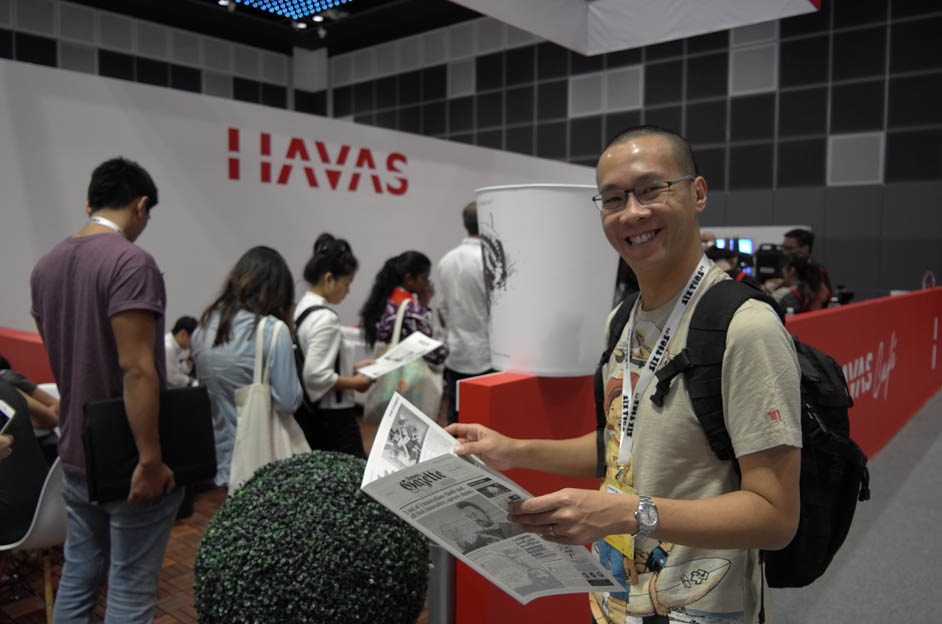
 The Sweet Shop’s Claire Davidson (pictured left) is on the ground at The Spikes Asia Festival, at Suntec City in Singapore. Here’s Claire’s highlights of the third day of seminars at the festival.
First up today I caught another seminar on AI. AI is becoming very much a buzz phrase and topic of discussion around and within our industry. ‘Sentience: The Artificial Intelligence Gameshow’ was brought to us by Chris Stephenson, Strategy Head of PHD, Asia, Julian Corbett, Founder and CEO of playTMN, Rob Campbell, Regional Head of Strategy of Wieden + Kennedy, Wynthia Goh, Director of Digital & Social of SAP Asia Pacific, Japan and Jean Danker, DJ of Media Corp Class 95FM.
The AI revolution ahead of us is where the world’s information will be ‘hierarchically ordered to create what is, ostensibly, consciousness but which actually utilises intelligence greater than every living human being on the planet’. In a quiz show set up this morning, we looked first at Alan Turing – whom we all know from The Imitation Game starring Benedict Cumberbatch. Turing brought us the very beginnings of AI. Our next question involved Watson, the AI computer developed by IBM, which is able to answer questions asked of it. Watson rose to fame by winning Jeopardy; beating two human competitors and taking home the prize money of $1million. Watson is composed of 200 pages of structured and unstructured content. Today Watson is used in the medical industry, with many nurses in the workplace follow its guidance.

 We learnt that it’s possible that forty seven percent of jobs are at risk of being made redundant over the next two decades. But do we believe this? Alternatively, how many new jobs are going to be created in this time? This we weren’t told. Software is going to get smart. It’s going to get creative. Machines will translate in real time. AI is built on knowledge. AI will push us to do things in not just a different way, but in a different, better way. Our gameshow contestants also discussed Machine Learning, the study and construction of algorithms that can learn from and make predictions on data, and the Google Brain, which is one of Google X’s projects that has its focus on deep learning research.
Will AI become just like a utility for us? Just like, say, electricity? Will we just plug it in and have it make our lives better?
We will have 20 billion connected devices in the next five years. We will all be using technology in a different way. Advertising and marketing once again will be turned on their heads, and this time we will be marketing to an algorithm rather than directly to consumers.
Our winner today with 80 points was Rob Campbell. Cheers for Rob, who incidentally is one of the funniest people I follow on Instagram and Facebook. Go Rob! Go Rob! Go Rob!

 Yonathan Dominitz, Founder of Mindscapes, next brought us ‘Constraints That Inspire Creativity and Innovation’. We often think that the best creative ideas come from a place without constraints, or where we break constraints and ignore constraints. Most of us dislike constraints. Our minds tend to see them as obstructive. Today Dominitz tossed this theory out the window.
Igor Stravinsky told us that ‘the more constraints one imposes, the more one frees one’s self. And the arbitrariness of the constraint serves only to obtain precision of execution’.
Constraints can inspire creative thinking, and lead us and fuel us to innovative ideas. Constraints can bring solutions. Problems can be used to create solutions. It’s not impossible to use creative use of problems correctly. Admitting a problematic truth can also be a powerful way to win trust and sympathy. If constraints are forcing us to be more creative, why not also use constraints intentionally. Use self-imposed constraints to speed up the process. Also consider creating dynamic connections between different variables of a system. Also acknowledge relocation.
We looked at case studies for Marmite – people either love it or hate it and Guinness – Good Things Come to Those Who Wait. Other examples we viewed were for Volvo, Geico, Pay Per Laugh and Intermarche.
‘No Way! Is The New Way!’ was brought to us by Takahiro Hosoda, Creative Director of TBWA\Hakuhodo and Kazuaki Hashida, Creative Director of Hakuhodo Kettle. I love these guys. They came on stage wearing their True Wetsuits, from their phenomenal Quicksilver range / campaign, allowing you to go straight from the boardroom to the beach. No Way! Yes Way!

 Hosoda and Hashida told us to stop the competition for ‘Likes’. Today we are all ‘Like’ seekers. But… is it always right for the campaign to get as many ‘Likes’ as possible? Do revolutionary campaigns always get ‘Likes’ at the beginning? No. They don’t. They get No Way! No Way! must become the New Way. We need to disrupt the status quo of the creative process.
The ‘Like’ approach only enhances existing engagement with an expected idea. The No Way! approach brings brand new engagement with an unexpected idea. If we seek only ‘Likes’ then brands stay only in their comfort zone. From brands looking for new users or keeping existing users they risk becoming inward looking and even stale or inflexible. Brands need a jolt. And then with that they need to amaze. Disrupt your core fans. Disrupt past behaviours. Disrupt past messages. Disrupt past media practices.
But where might we find a No Way idea? It’s easy to find a ‘Like’ idea. If everybody ‘Likes’ your brand or your campaign then something is missing. ‘Like’ comes from agreement. No Way! comes from argument and controversy. Pros and cons are needed.
How might we turn nays into yeas? ‘Like’ only needs a presentation. No Way! requires a demonstration to convince. Rather than show you, aim to shock you.

 How might we come up with a No Way! Idea? Don’t look at what’s possible? This gives you only typical ideas. What you really need to ask yourself is what’s impossible? And ask yourself this from the very beginning.
Do consumers really want a No Way! idea? A No Way! idea typically gets a poor rating in research. People rate what they know. To examine at this we again went back to Henry Ford’s quote, ‘if I had asked people what they wanted, they would have said faster horses’.
‘Like’ only follows what people want. No Way! also follows what they hate. Want will turn into hate. ‘Like’ ideas can stop the brand from weakening. No Way! ideas help the brand to energise.
Our key take-outs from Hosoda and Hashida today are:
(Like) Agreement ~> Argument (No Way!)
(Like) Show you ~> Shock you (No Way!)
(Like) What’s possible ~> What’s impossible (No Way!)
(Like) Want ~> Hate (No Way!)

 The future is always born from the No Way!
Cheuk Chiang, Chief Executive Officer of Omnicom Media Group, Asia Pacific and Lakish Hatalkar, Vice President OTC of Johnson & Johnson, Asia Pacific brought us ‘Creative With A Conscience’. Brands today need to have a clear sense of purpose. What if the business we are all in can no longer been seen as ‘fluffy’? What if advertising had substance? Heaven forbid!!! What if advertising could change lives? (hang on, does it not?)
Brands can express what they do. But not every brand can express its purpose and why it does what it does. What we need to do is start with the why. People don’t buy what you do. They buy why you do it. We need to understand our purpose. Businesses need soul, and the why is the soul.
Creativity can save lives. It doesn’t have to be about life and death. It can be about livelihoods. It can be about communities. It can be about families. Creativity can serve a purpose. Now is the time for creative to have a conscience. The current generation of Millennials has seen more change than any other generation in the history of our world. The pace of change is growing at an exponential rate. There has been a shift in focus from the need of security (health, property, employment) to purpose (personal identity and self esteem). No longer is it about delivering a good product, but brands must have this strong sense of purpose.

 Paul Polman, CEO of Unilever has told us ‘this is a great time for brands which can provide a beacon of trust for consumers’. These days CEOs don’t just get judged by how well their share prices are doing, but by what impact they are having on society’.
Brands need to be responsible. They need to give back. We need to re-engineer our businesses, our brands, our products, and our services. We have to make a difference. We have to take a stance. It starts with us as individuals. It all starts with me.
~ Check me.
~ Correct me.
~ Protect me.
~ Remind me.
We’re all capable of creating with a conscience. Anyone can save a life. Take a stance. If you don’t stand for something, you’ll fall for anything.
Last up for me today was ‘Being Human: Creativity X Technology’ with Prathik Thakar, Head of Creative Content and Design Excellence of The Coca Cola Company, Asia Pacific and ASEAN and Sven Huberts, Managing Director of Isobar, Asia-Pacific.

 How do we keep the human emotion at the forefront of what we do in today’s technological age? How do we embrace technology while always maintaining a human touch? The Coca Cola company has always been at the forefront of this, and is a champion at producing tech savvy campaigns that are coupled with human connection.
There are no rule books to follow. Thakar tells us to act with your character, and within your culture. Be genuine. Being global, Coke operates in different situations in different ways. They are constantly looking at new ways to innovate. It is here where they harness technology to improve and strengthen their creativity. In a sense they have started to own the language.
Listen to your consumers. Be current. And act. Coke often shows its humanity in times of world crisis. Here you can’t sit back and just keep market your product. Take Coke’s Small World Machine campaign in India and Pakistan, and when the company helped to build houses in The Philippines after Typhoon Haiyan. Coke as a brand stands for something. They also created a successful social responsible water brand in China. If you drink this water it helps rural schools and villages in China. Coke is saying that this is the platform that we stand for, so please join us. The platform is given to the consumers. Technology allowed Coke to talk with people, as well as create education. Drink good. Feel good. Do good.

 We also looked at a case study of Coke’s ‘Share A White Christmas’ campaign, which was shot in both the Arctic Circle and Singapore, and was incidentally produced by myself and The Sweet Shop (self promotion, self promotion, self promotion!) This is a human story that we were able to create with technology between countries. Through Skype and webcams we brought snow and a white Christmas from Finland to Singapore in real time. Apart from the event itself in both countries, an online video was also produced and shared.
The world famous ‘Share a Coke’ campaign is itself a new platform. Now personalised bottles can be created to spread more of Coke’s happiness. Even my favourite emoji’s have been added. J J J From a packaging to a POS to a social idea this works and it works amazingly well.
We looked too at The Slender Vender for Diet Coke. Initially a design idea, Coke needed to work out how to commercialise it. There wasn’t anywhere to put money in the machine. Coke knew they wanted to produce this, and regardless of the absence of the money slot, decided to instead
use it as a sampling machine, and created experience around it on social media. We also viewed the Drinkable Advertising for Coke Zero, which I wrote about earlier in the year at the Cannes Lions.

 People’s emotional connection is the discerning factor for Coke, and that meaning can be heightened by harnessing technology. Coke connects the dots. Coke connects as a company, and Coke connects their consumers.
The Coca Cola Company culture is to stay timeless and timely. With that they are truly remarkable.
Thank you Spikes Asia 2015 for another inspirational three days. It’s now time to frock up for the Gala Awards Ceremony and After Party. Good luck to all of the finalists and those in completion. See you again in 2016.
Claire Davidson, Managing Director + Executive Producer ASIA & MENA @ The SweetShop, reporting for Campaign Brief Asia at Spikes Asia 2015.

